The diversity of Vietnam's sand

April 2024: In the joint project RENO-TITAN at the Department of Water, Environment, Construction and Safety, it is being investigated whether residues from Vietnamese titanium mining can be recycled due to the prevailing shortage of construction sand there.
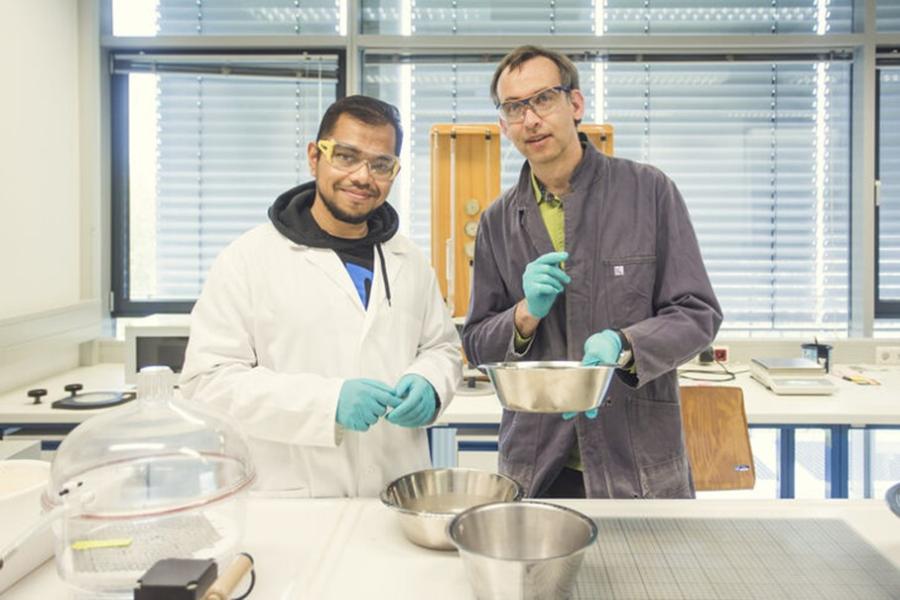
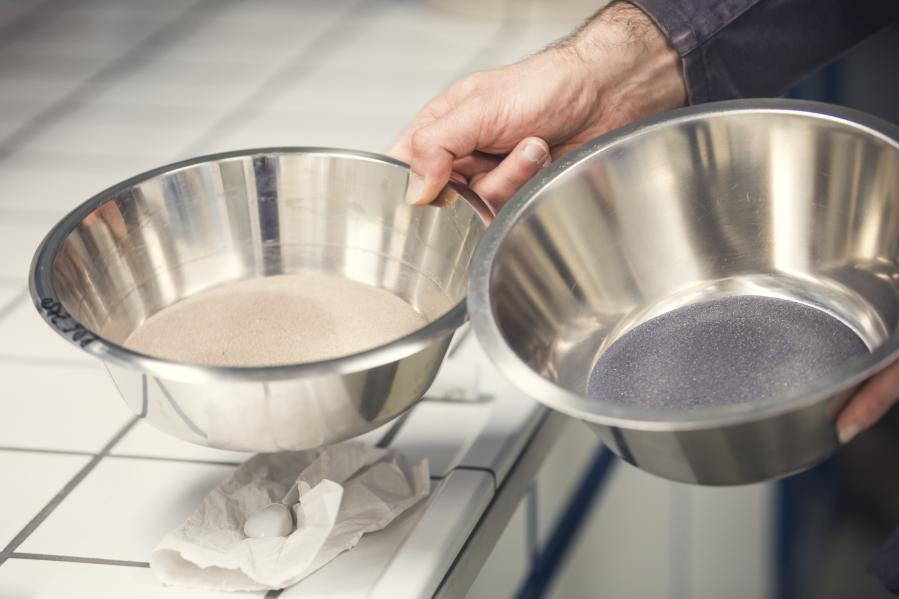
Even from a distance, the screening machine in the laboratory hall of Magdeburg-Stendal University of Applied Sciences can be heard vibrating. However, it is not just any sand or sand from the Elbe that is being examined here, but sand from Vietnam. Interspersed with black specks, a small sample of it lies in bowls next to the screening machine. These specks are a versatile and therefore highly sought-after mineral containing titanium, which is mainly used for the production of white pigment. Paints, plastics, and even toothpaste – the white pigmentation is based on the element titanium, which gives the RENO-TITAN project its name.
The joint project started in April 2023 and is funded by the Federal Ministry of Education and Research (BMBF). RE stands as an abbreviation for the English word 'reuse' and means reuse. NO comes from the term 'Naturally occurring radioactive material' (NORM) (= naturally occurring radioactive materials). "The sand does contain heavy titanium-bearing minerals, but also radioactive substances. The more the desired mineral is concentrated, the more radioactive elements are also enriched," explains Conrad Dorer, biochemist and scientific staff member in the RENO-TITAN project. The concentration is carried out using spiral concentrators, in which the sand is separated based on different densities.
Together with two other German and three Vietnamese partners, the project from the field of engineering ecology is investigating the mining residues of the titanium industry from Vietnam. There has been a construction sand shortage there for some time, which is mainly attributed to the increase in new construction, according to Dorer. The residues are to be tested in Germany and Vietnam for their recyclability as a construction material.
Already in titanium mining in Vietnam, radioactivity is measured in some substances. According to the Federal Office for Radiation Protection, radioactivity surrounds us daily and everywhere in our environment, including in our food. "When people think of radioactivity, many think of uninhabitable places and health-threatening radiation," says Kazi Nafiul Hassan. He is studying Water Engineering in the Master's program at Magdeburg-Stendal University of Applied Sciences and has been working as a research assistant at RENO-TITAN since March. "With our investigations, we want, among other things, to find out how to properly handle naturally radioactive substances and whether sustainable solutions can be found," says Hassan.
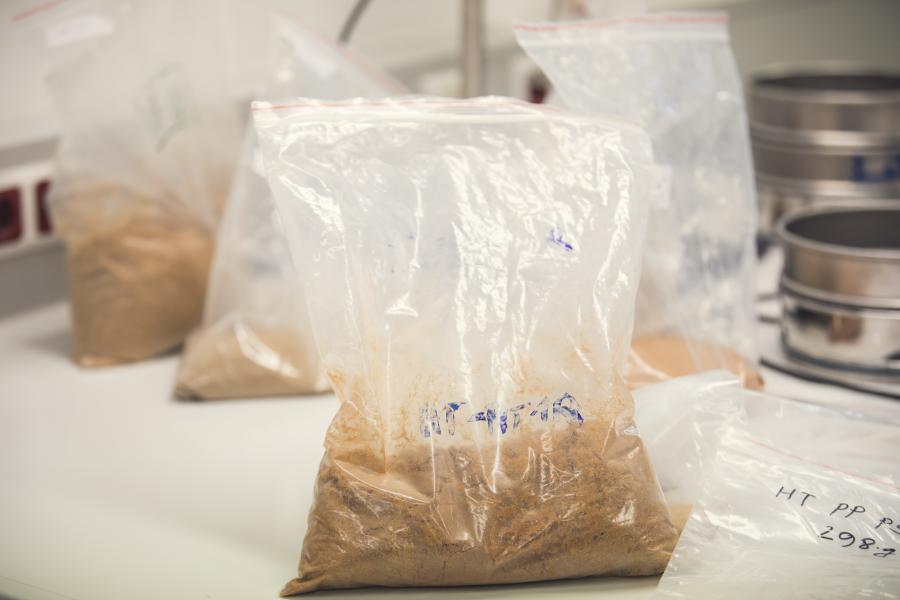
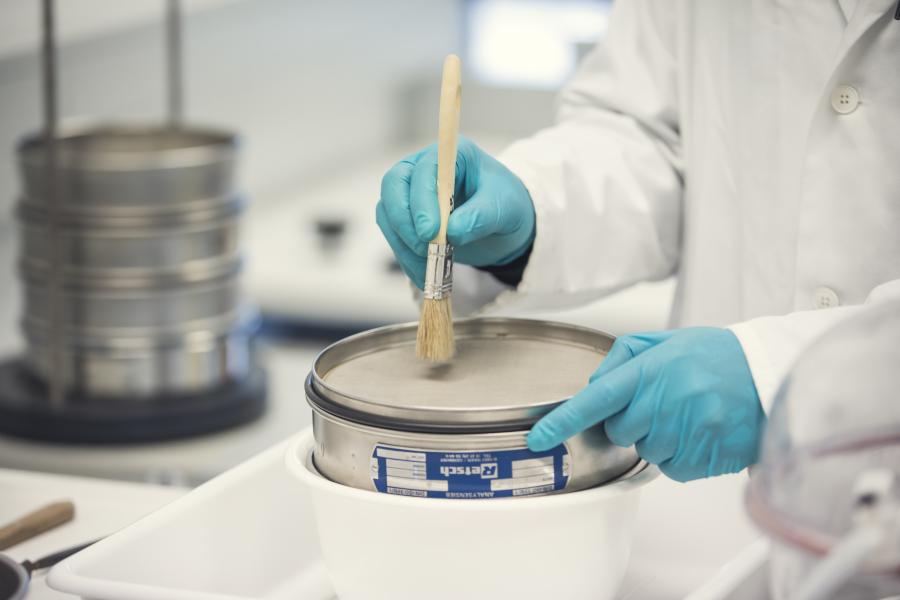
The investigations are currently in full swing. The sand samples are sieved through meshes of varying fineness in order to divide them into fractions and characterize them. The more the project partners know about the properties and behavior of the materials, the sooner a decision can be made about what they might be suitable for in further processing. In September, a study visit by the Vietnamese partners to Germany is planned, during which all measured data will be discussed. Until then, Dorer and Hassan are examining the Vietnamese sand samples down to the last grain.
Text: Leonie Deubig. First published here.
At a glance
Utilization of NORM residues from the titanium industry in Vietnam
Duration: April 2023 to March 2026
Funding volume (BMBF): 506,654 euros (share of the university)
Consortium partners in Germany: G.E.O.S. Ingenieurgesellschaft mbH Freiberg/WISUTEC GmbH, IAF Radioökologie GmbH
| Voriger Beitrag | Zurück zur Übersicht | Nächster Beitrag |